
Strategic Memorization Techniques for Language Mastery
Unlock 2 Effective Memory Strategies

In 1620, Francis Bacon wrote, “If you read a piece of text through twenty times, you will not learn it by heart so easily as if you read it ten times while attempting to recite from time to time and consulting the text when your memory fails.”
Memorization is not only about repetition but also about intelligent repetition. Indeed, as you saw in the last articles, consistency is the key, whatever your project, especially in learning a foreign language.
You must study or work every single day, even if it is for a few minutes, regardless of your willingness to do it.
You can also use several tools to help you in your memorization process, as evidenced by the University of North Carolina in this article: Memorization Strategies – Learning Center (unc.edu).
However, there are two methods that you should especially focus on, which are spaced repetition and the blank page test. These two methods helped me perform well during my studies and reach a very good level in four different languages and a variety of topics I wanted to improve in.
#1 Spaced Repetition
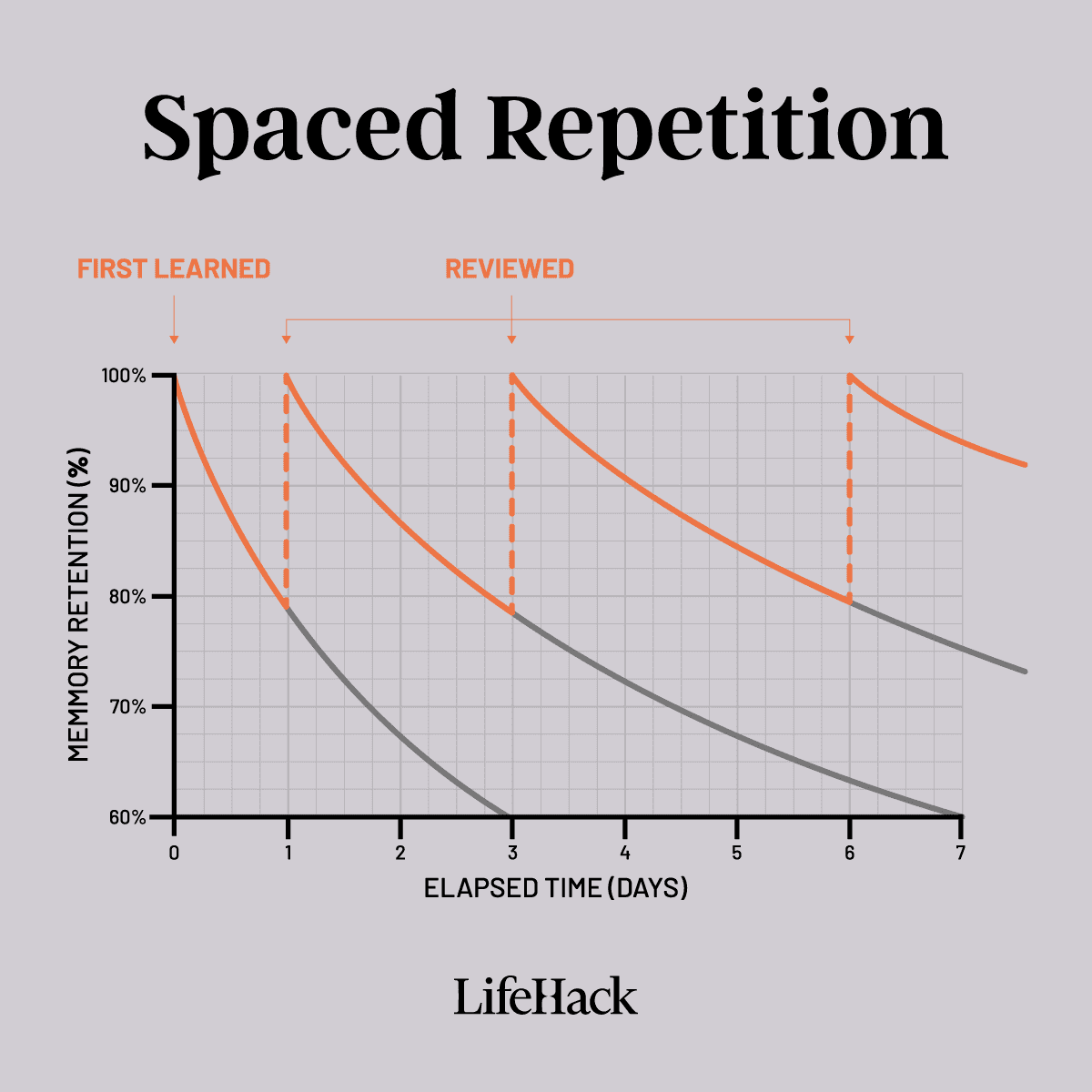
Even though you are working on your foreign language every day, you should space sessions for the sentences, verbs, nouns, and situations you have studied to make them stick in your memory.
For instance, if you study a text today concerning the theme of “family and friends,” you should plan a study session on this topic a few days later, then one week later, then 10 days later, and so on.
The topic studied will be completely mastered after a few study sessions. You will be able to use it for a long time, making your learning process especially efficient.
The graph below shows the level of retention according to the repetition you do of your study sessions. After a few spaced repetitions, 90% of what you have learned will stay, which is powerful.
#2 The Blank Page Test
Daily, as soon as you start your study session, what you must do is ask yourself questions about what you studied the day before.
What did you learn? In which context?
To make it stick, what you need to do is write everything on a blank page. Everything you remember from your previous session. Recall the situation and the links you built.
You will be able to see if you did some deep work and were 100% focused on what you were doing or if you were thinking about something else while studying.
Next, check with the materials you used during the session. What didn’t you remember? Why? Then write down the things you forgot on the same paper and read it again the day after. The closer you read it to your bedtime, the better it will be for your memory.
Of course, it is impossible to remember everything the first time. But a good combination of spaced repetition and self-test will make you unbreakable at mastering a new foreign language.
It might be a bit difficult to implement at first sight, but the value you will gain from it is absolutely amazing.
That concludes today's insights. Feel free to reach out with any questions you may have. Share this with someone keen on learning foreign languages and, of course, consider subscribing.
I'm delighted to see our community of learners growing, and your participation brings me joy.
Thanks for these tips. So question: How do we use these techniques if we are learning these languages through Duo Lingo? I go through lessons daily on Duo Lingo but I am not still comfortable talking or reading a newspaper yet, say in Spanish or German - these languages that I am learning at the moment.